
Where are we on the S curve?
John Hoskins • March 7, 2026
So I was thinking about SpaceX, and the supposed valuation of a trillion dollars. And part of this whole thing is the idea that there is a lot of growth left.
So last year, I think it's last year, SpaceX did approximately $15 billion in revenue, with $10 billion from Starlink and about $5 billion from launches. There are some notes bandied about that there's somehow $8 billion of profit. I don't understand that, but just that really doesn't matter for now. So the question really is, when it comes to Starlink and its service, who needs it? Or I should say, the question is, what is the total addressable market?
And how close are they to getting to the saturation point of that total addressable market?
The projections of SpaceX being worth so much is really based around this idea that they are top of the game, no competition, and most importantly, that they have huge growth prospects. So my question is, who needs Starlink? Who doesn't have it today?
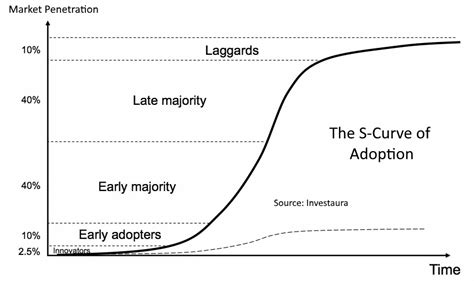
So when we just do a little bit of analysis, it's good to bring up the S-chart. The S-chart is the adoption curve that we see and is a good model for lots of technologies. It starts off very low, and at some point it hits a fairly big increase from insignificant to increasingly significant until it hits a point where it's kind of straight, and adoption is growing for some period of time, and then as it reaches saturation up near the top of the line, it curves again to slow where adoption growth slows down. But if you go and look at it, look at the SpaceX numbers, and go look at the Starlink numbers, those numbers seem to show that they are in, or soon to be reach, saturation point. So with the idea that they're going to go public with this growth story, where is the future growth? That is not to say that the current profit margin isn't whatever it is, isn't good, but that there is some 10x, 100x of growth yet to be had out there.
So where are they on the S-curve, on their existing Starlink product? There is much talk about putting tens and tens of thousands more satellites into the air, including AI data centers, which is fanciful and ridiculous. But of their core today business, how much growth is left? That's the question. And you can go look at all kinds of SpaceX as well as Tesla business line, and you ask the same question. Where are we on the adoption curve? Are we near the bottom of the S? Are we near the top of the S? Have we basically reached saturation and the market will grow at an organic rate that's much less than triple digits? That's the question.
The last point I would make overall is the idea that there is so much capital out there that every business that can convince investors has the opportunity to speed run through the business development cycle. Or claim that they can. The current Starlink setup was put up 24 or 28 satellites into orbit per launch. The idea is that thousands more could be put up in batches of 400. If only there was any demand that was not being met. I look forward to seeing the totally unreasonable valuation of SpaceX when it tries to IPO and tell me it has some magic untapped market.